Learning how to sanitize your personal makeup is one of those things nobody teaches you, but everyone should know. Think about how often you touch your face throughout the day, then think about how often you actually clean the tools and products you use to do it. If it has been a while, you are definitely not alone. This guide walks you through exactly how to clean and disinfect every part of your makeup bag, from brushes and powders to lipsticks and mascara, so you can keep your skin healthy and your products working their best.
Here is what we will cover:
By the end, you will have a simple routine you can actually stick to, so your makeup stays safe, fresh, and ready to use.
Every time you dip a brush into powder or swipe a lipstick across your lips, you are transferring oil, dead skin cells, and bacteria onto that product. Over time, this buildup does not just sit there quietly. It multiplies.
Old, dirty makeup can lead to some annoying and even painful problems, including:
The good news is that different products need different care. A powder eyeshadow is not cleaned the same way as a liquid foundation, and a lipstick needs a different approach than a mascara wand. Once you understand the basics for each category, sanitizing your makeup becomes a quick habit rather than a chore.
Brushes and sponges pick up more bacteria than almost anything else in your makeup bag because they touch your skin and your product over and over again. Here is a simple way to keep them clean.
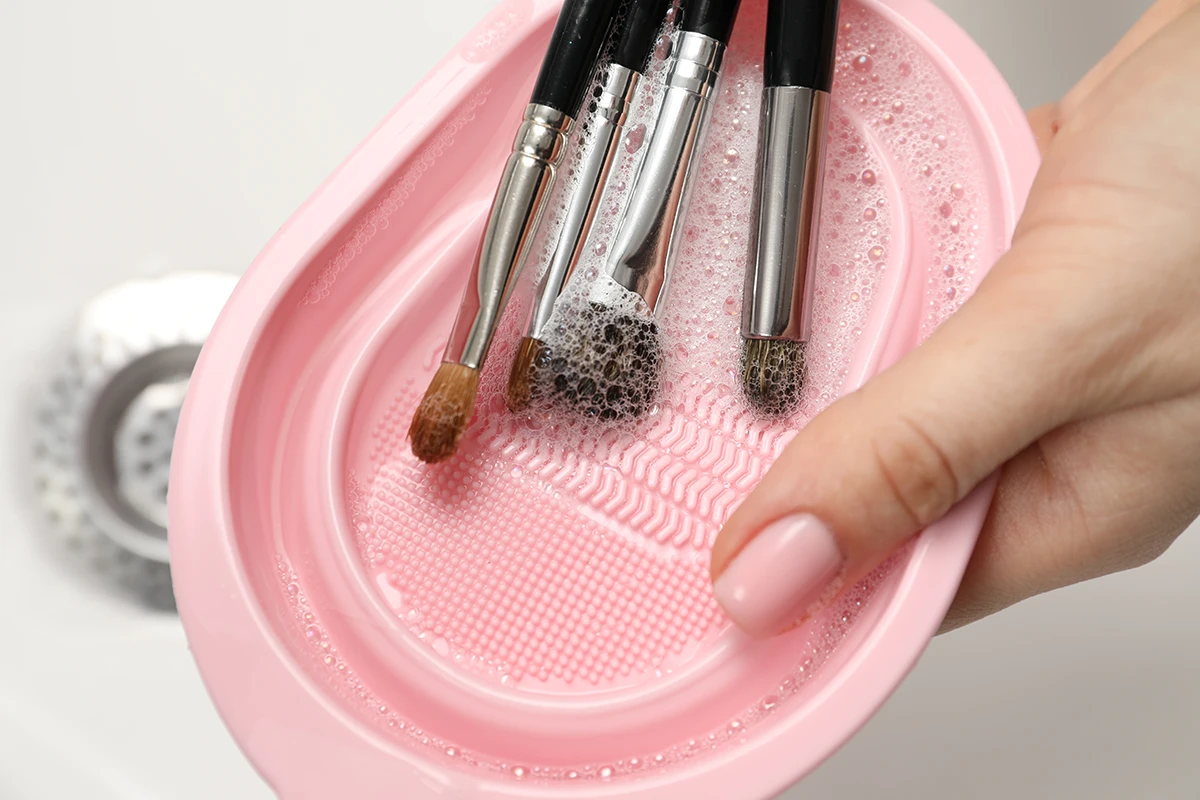
For brushes, wet the bristles with lukewarm water, then work a small amount of gentle soap or a dedicated brush cleanser into the bristles using circular motions in your palm. Rinse until the water runs clear, gently squeeze out the excess water, and reshape the bristles before laying them flat to dry. Avoid standing them upright while wet, since water can seep into the handle and loosen the glue holding the bristles in place.
For sponges, like beauty blenders, wet them first, then massage a bit of soap into the material until the product releases and the water turns clear. Squeeze out the excess and let them air dry fully before storing.
As for how often to do this, brushes used for powder products can be washed once a week, while brushes used for cream or liquid products should be cleaned more often, ideally every few uses, since they hold onto product and bacteria more easily. Sponges should be washed after every use, since they stay damp and are a magnet for bacteria growth.
Pressed powders feel low maintenance, but they still need attention. Bacteria and oil transfer from your brush onto the surface of the powder every time you use it.
To disinfect a powder product, lightly spritz the surface with 70 percent isopropyl alcohol from a small spray bottle. Let it sit for a minute so the alcohol can kill bacteria on contact, then use a clean tissue to gently blot away any excess moisture. The alcohol evaporates quickly and will not damage the pigment or texture of most powders.
If your palette has a layer of built-up oil or old product on the surface, you can gently swipe it away with a dry cotton pad before spraying. Just be careful not to press too hard on cracked or crumbly powders, since extra pressure can cause them to break apart. If a powder does crack, pressing it back together with a bit of rubbing alcohol and letting it dry can actually repair it.
Cream and liquid products are a little trickier because the bacteria risk is not just on the surface. It can also be at the opening of the bottle or tube.
Start by wiping down the nozzle, pump, or cap opening with a cotton pad dampened with rubbing alcohol after every use. Product tends to collect right at the opening, and that is exactly where bacteria loves to grow.
One of the biggest habits to break is double dipping with your fingers. Every time you touch a cream product with unwashed hands, you introduce new bacteria straight into the container. Instead, use a clean spatula or the back of a clean brush to scoop out what you need.
It also helps to know when a product needs more than a wipe down. If foundation or concealer starts to smell off, separates in a way that will not blend back together, or changes color, it has likely expired and cleaning will not fix it. At that point, it is time to toss it and start fresh.
Lip products go directly onto one of the most sensitive areas of your face, so keeping them clean matters more than people realize.
For lipstick, wipe the bullet with a tissue soaked in rubbing alcohol after each use, focusing on the top layer where your lips make contact. You can also lightly spray the surface with alcohol, let it sit for a few seconds, and wipe clean. If you want a deeper clean, you can shave off a thin layer of the lipstick with a clean tool to remove any buildup entirely.
Lip liners are actually easier to keep clean because sharpening them removes the outer layer along with any bacteria that built up on the surface. Just make sure to sharpen before each use if the liner has not been used in a while.
Glosses with a wand applicator need a bit more caution, since the wand goes in and out of the tube repeatedly. Wipe the wand with a tissue before placing it back in the tube, and never share gloss applicators, even with friends or family. If the wand or formula starts to feel sticky or smells different than usual, it is a sign the product has reached the end of its safe life.
Eye products deserve extra care since your eyes are especially sensitive to bacteria and infection.
Mascara has the shortest safe lifespan of almost any makeup product, typically around three months. Because the wand moves in and out of the tube constantly, it pumps air and bacteria back into the formula every single time. Wiping the wand will not solve this the way it does for other products, so the best practice is simply replacing mascara regularly rather than trying to sanitize it long term.
Eyeliner pencils can be sharpened before use, just like lip liners, which removes the top layer of bacteria along with any buildup. Gel and liquid eyeliners are more like mascara in that they are harder to fully clean, so wiping the wand or brush with alcohol after use helps, but replacing the product every few months is still the safer choice.
When it comes to eye products in general, if you ever develop an eye infection, throw out any mascara, eyeliner, or eye product you were using at the time. Reusing it, even after cleaning, can reintroduce the same bacteria.
Sanitizing individual products matters, but daily habits are what actually keep your whole collection cleaner over time.
A few simple habits make a big difference:
None of these habits take extra time out of your routine, but together they can dramatically extend the life of your products and reduce your risk of skin issues.
Beyond quick daily habits, it helps to have a regular deep clean schedule.
Building this into your regular skincare and hygiene routine makes it feel far less like a chore and more like second nature.
Sanitizing your personal makeup does not have to be complicated. A little rubbing alcohol, some soap and water, and a few consistent habits go a long way toward keeping your brushes, palettes, lipsticks, and liners clean and safe to use. When your tools and products are clean, your makeup applies more smoothly, lasts longer, and is much less likely to cause breakouts or irritation.
If you want to build these habits into a broader, hands-on understanding of makeup application and hygiene, our makeup and Hair Classes in Columbus, Ohio are a great next step for learning directly from professionals.